In a July 2, 1919 advertisement in Oregon’s Daily Capital Journal, Anheuser-Busch promoted Bevo as “The all-year-’round soft drink.” A familiar brewing company was selling something very different from its usual beer. oregonnews.uoregon.edu
What happened to beer during Prohibition? Ordinary alcoholic beer lost its lawful commercial market, but beer didn’t simply disappear. Low-alcohol substitutes remained available, prohibited brewing continued, and some breweries found other products to sell. Understanding beer prohibition means separating what the law allowed from what businesses produced and people actually drank. constitution.congress.gov
The story of 1920s beer is therefore more interesting than a country going dry and suddenly getting thirsty again. It’s a story of changing labels, difficult business decisions, and a return to legal brewing that happened in stages.
beer prohibition
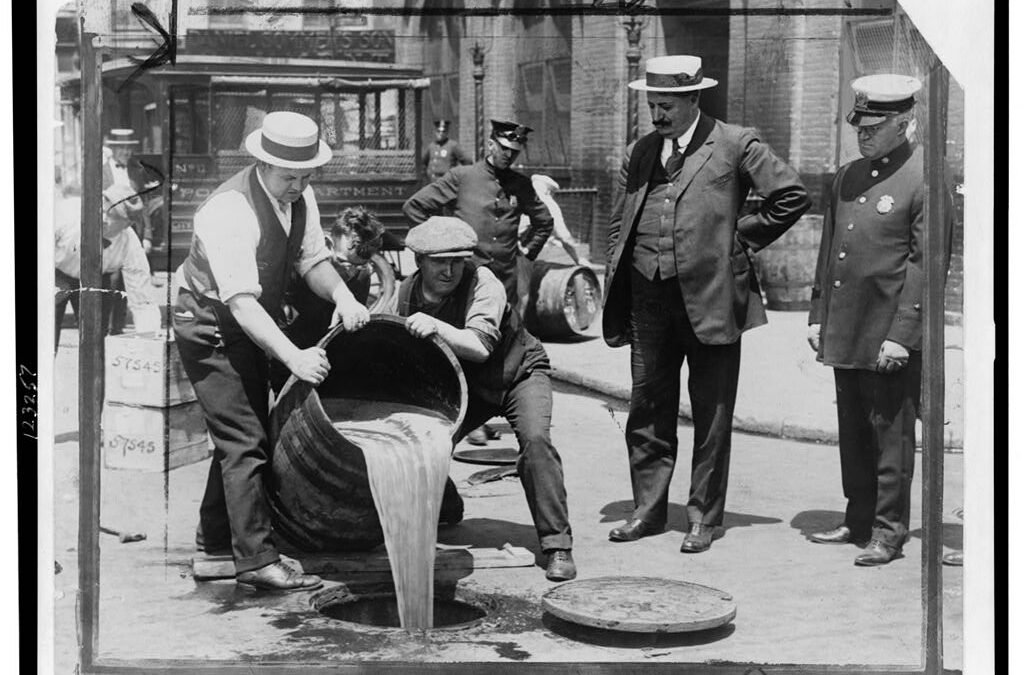
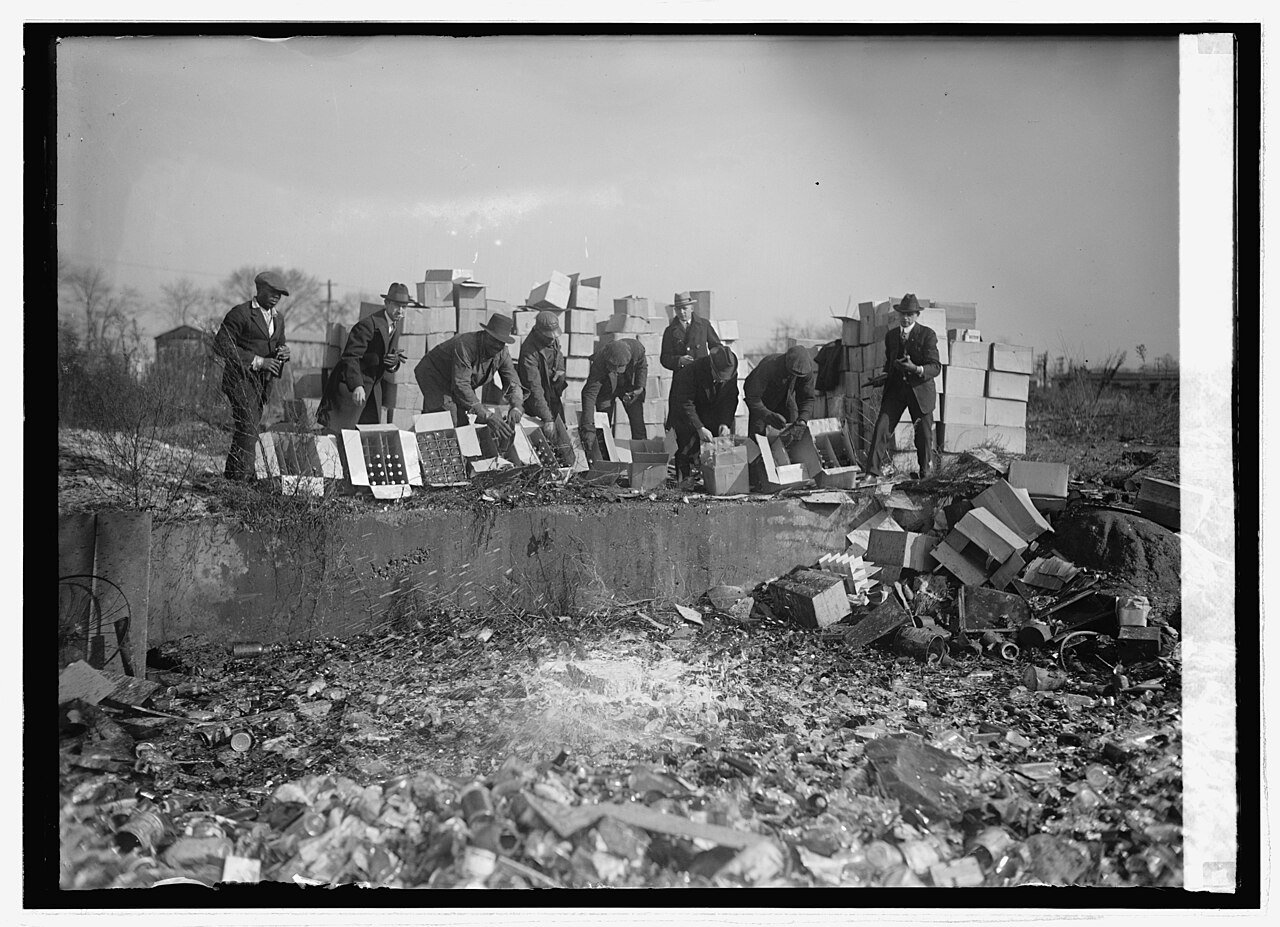
Beer prohibition was the restriction of the manufacture, sale, and transportation of beer covered by national Prohibition law, not a blanket declaration that every act of drinking beer was illegal. National constitutional Prohibition began on January 17, 1920, after the Eighteenth Amendment had been ratified the previous year. constitution.congress.gov
These five dates keep the sequence straight:
| Date | What changed | What it meant for beer |
|---|---|---|
| January 16, 1919 | The Eighteenth Amendment was ratified. | The constitutional prohibition was approved, with its operative restriction taking effect after a one-year interval. National Archives |
| October 28, 1919 | The Volstead Act became law. | Congress supplied definitions, enforcement provisions, and exceptions for national Prohibition. senate.gov |
| January 17, 1920 | National constitutional Prohibition took effect. | Ordinary alcoholic beer could no longer move through its previous lawful commercial channels. fjc.gov |
| April 7, 1933 | The Cullen-Harrison Act’s beer provisions took effect. | Qualifying beer returned where state law permitted, subject to the act’s conditions. constitution.congress.gov |
| December 5, 1933 | The Twenty-first Amendment was ratified. | National constitutional Prohibition ended, although state restrictions still mattered. National Archives |
The Eighteenth Amendment established the constitutional restriction on intoxicating beverages. The Volstead Act made that restriction workable as an enforcement system. Keeping those roles separate explains why a later change to the statute could bring certain beer back before the amendment itself was repealed. National Archives
Nor did alcohol restrictions begin from a standing start in 1920. Earlier temperance campaigns had produced state prohibitions, while federal wartime measures had already constrained alcohol production and sales. Brewers approached national Prohibition after years of mounting pressure, not one surprising morning. fjc.gov
For a brewery, the practical problem was enormous: its established product could no longer be manufactured and distributed for ordinary beverage sales as before. Having a recognizable brand, a bottling line, and willing customers did not make that business lawful.
Private behavior requires more careful wording. Federal law protected certain lawfully acquired stocks kept at home for the owner, family, and genuine guests. It also provided controlled exceptions for purposes such as medicine and religious use. Those qualifications did not authorize unrestricted commercial beer sales, but they explain why “all drinking became illegal” is the wrong summary. constitution.congress.gov
1920s beer
People encountered several different things under the broad heading of Prohibition beer: lawful low-alcohol cereal beverages, alcoholic beer produced outside legal channels, and familiar brewing companies selling unfamiliar products. There wasn’t one national “1920s beer” with a standard recipe, strength, or drinking experience. The surviving evidence points to a divided market rather than a single replacement drink. blogs.loc.gov
Legal substitutes and beer outside the law
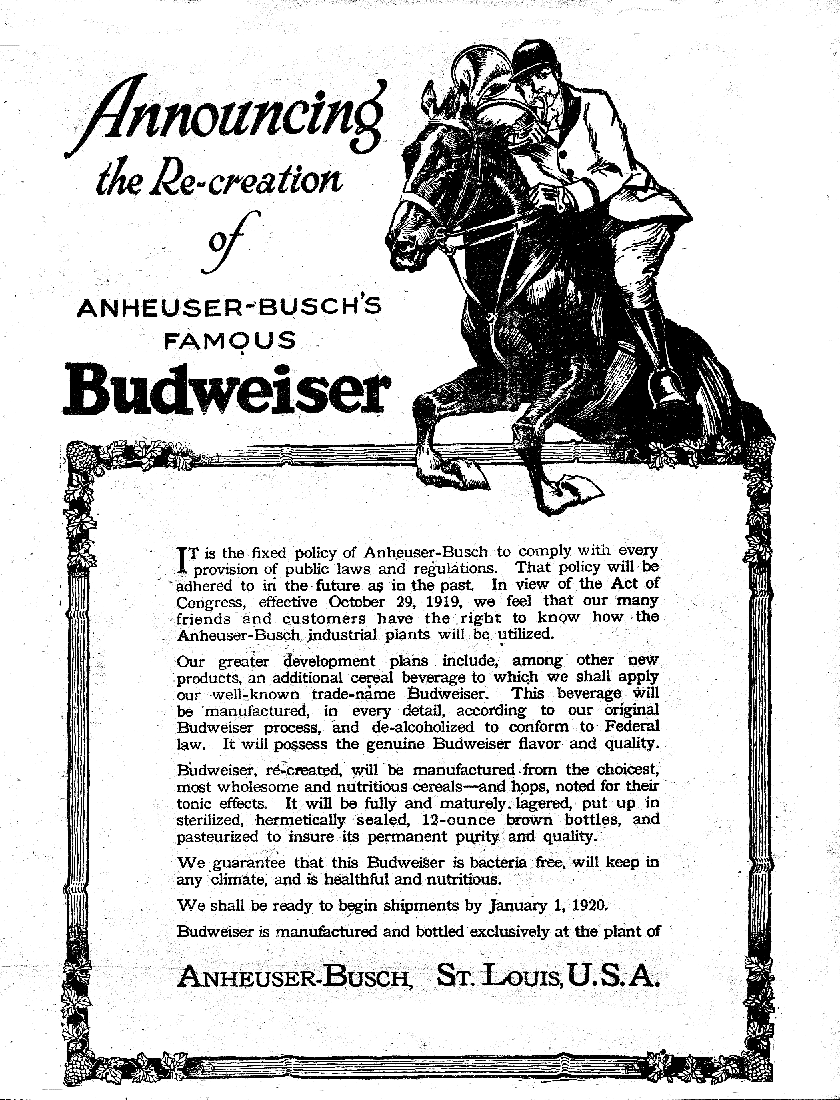
Near beer was one visible part of that market. The Library of Congress identifies advertisements for Anheuser-Busch’s Bevo and Pabst’s Pablo, alongside other examples of brewers moving into nonalcoholic products. It also documents malt extracts advertised for baking that were used in illegal home brewing. The legal product and its eventual use were not always the same story. blogs.loc.gov
That distinction matters when picturing the decade. A publicly advertised cereal beverage was not equivalent to prohibited alcoholic beer obtained through an illicit supplier. Nor does evidence that home brewing occurred tell us how frequently every household brewed or what every batch tasted like.
Low-alcohol alternatives were also discussed openly. A New York Tribune feature dated August 29, 1920, covered near beers and ginger beer, as highlighted by the Library of Congress. Beer substitutes belonged to the period’s public conversation, not merely its secret nightlife. blogs.loc.gov
What a surviving advertisement can tell us
Return to the Bevo advertisement that opened this story. Its date places it before national constitutional Prohibition. Its wording presents Bevo as a soft drink, while references to grocers, druggists, and distributors position it within ordinary retail life. oregonnews.uoregon.edu
The advertisement establishes what the company was promoting in that place and moment. It does not establish universal popularity, precise alcohol content, or taste quality. Even its claim that Bevo was “Sold everywhere” is advertising language, not a national inventory. oregonnews.uoregon.edu
That’s a useful habit for reading any historical beer label: check the date, identify the product, and separate the seller’s promise from what the document can actually demonstrate.
How breweries kept their businesses alive
Surviving brewery names can make survival look inevitable. It wasn’t. The following examples show three different responses to a disrupted market, not a recipe that every brewing business could follow.
Anheuser-Busch: Staying in the beverage business with Bevo
Bevo offered Anheuser-Busch a way to sell a beer-like beverage as restrictions tightened. A surviving Bevo shipping crate in the Smithsonian’s National Museum of American History provides physical evidence of that commercial operation, beyond the attractive newspaper advertisements. americanhistory.si.edu
The business logic is straightforward: a beverage still needs production facilities, packaging, shipments, and customers. Selling another drink offered opportunities to keep parts of a brewing organization working, even when its main alcoholic product was restricted.
But an alternative product was not a guaranteed success. A later federal court opinion recorded sharp declines in Bevo sales and the accumulation of bottles and cases that had become obsolete. It also described Anheuser-Busch’s efforts to find other products that could use its resources. openjurist.org
That makes Bevo more revealing than a simple tale of clever reinvention. A company could adapt, remain in business, and still face expensive disappointments along the way.
Yuengling: Near beer and a dairy business
Yuengling’s own history describes a combination of low-alcohol cereal beverages and a dairy operation. Its account of the company’s 1929 centennial identifies products including Yuengling Special, Juvo, and Por-Tor, showing that the brewery was maintaining a beverage business during Prohibition rather than merely waiting for repeal. Yuengling
The company’s official FAQ also identifies the dairy and ice cream business as part of its survival strategy. That gives the story two distinct branches: adapting beverages and adding a separate food enterprise. Yuengling
The editorial interpretation is that Yuengling spread its opportunities across more than one lawful market. Near beer kept the business connected to malt beverages; the dairy offered another source of trade.
That does not mean ice cream was made in beer equipment, or that every brewery employee moved seamlessly into dairy work. Those details require their own evidence. The documented point is the combination of activities, not an effortless conversion of one factory into another.
Pabst: Putting the company name on cheese
Pabst took a different route into food. Its corporate history records the Pabst-ett cheese business, and the Library of Congress independently identifies cheese among Pabst’s Prohibition-era adaptations. Pabst
The Smithsonian also holds a Pabst cheese shipping crate. Like the Bevo crate, it turns an often-repeated anecdote into something tangible: a packaged product moving through commerce. americanhistory.si.edu
Cheese did not preserve brewing in the same way that a malt beverage could. Its significance was broader business diversification. A company associated with beer could seek revenue from something people could legally buy, even when that product belonged on a plate rather than in a glass.
Here’s how the responses compare:
| Company | Documented adaptation | Period | What the example illustrates |
|---|---|---|---|
| Anheuser-Busch | Bevo and other nonalcoholic beverages | Before and during national Prohibition | Continued beverage production and packaging, with substantial commercial risks. openjurist.org |
| Yuengling | Low-alcohol cereal beverages plus dairy and ice cream | Prohibition era | A combination of beverage continuity and a separate food business. Yuengling |
| Pabst | Pabst-ett cheese | Prohibition era | Diversification beyond beverages into packaged food. Pabst |
The important difference is what each response could preserve. Keeping a beverage operation active, maintaining a company’s income, and preserving an unchanged beer recipe are three different achievements. Evidence of one should not automatically be treated as evidence of all three.
Near beer and the changing meaning of a beer label
Near beer is a useful historical term for low-alcohol, beer-like substitutes, but it should not be mistaken for one standardized formulation. To understand what could legally be sold, the original statutory wording matters more than the nickname.
The Volstead Act’s definition included covered beverages containing 0.5% alcohol by volume or more. Its qualified exception applied below that level. Exactly 0.5% was therefore not automatically on the permitted side of the original threshold. DocsTeach
The exception also involved more than a laboratory reading. The act referred to production requirements, prescribed sealed and labeled containers, and naming the exempt beverages otherwise than beer, ale, or porter. Simply lowering the alcohol and keeping everything else unchanged was not the whole legal picture. DocsTeach
A legal category is not a tasting note
An alcohol threshold tells you something about legal treatment. It does not tell you whether a drink was sweet, bitter, dark, pale, satisfying, or disappointing. Those questions need evidence about the particular product, ideally including its ingredients, manufacturing records, or contemporary descriptions.
There were also different production approaches. Findings reproduced in the Anheuser-Busch court case distinguish Bevo’s arrested-fermentation process from competing beverages made by brewing alcoholic beer and subsequently removing alcohol. “Near beer” could cover products reached by different routes. openjurist.org
For a modern reader, the safest comparison is therefore limited: these were attempts to sell beer-like beverages under restrictive conditions. A Prohibition-era cereal beverage should not automatically be equated with a current bottle marked 0.0% or nonalcoholic.
The resemblance may be useful as a starting point, but it is not proof of identical alcohol content, regulations, recipes, or flavor. Read the old label as a historical document, not as a modern product specification.
Why beer returned before national Prohibition ended
Beer returned in stages because changing an enforcement statute and repealing a constitutional amendment were different tasks. Congress could alter the treatment of qualifying beverages while the constitutional repeal process continued. That is why beer legalization in 1933 has an April milestone as well as a December one. senate.gov
The political context had changed, too. During the Depression, arguments for modification emphasized employment and tax revenue as well as opposition to Prohibition. The Senate’s historical account describes the push to restore beer sales while broader repeal was still being pursued. senate.gov
What the Cullen-Harrison Act allowed
Signed on March 22, the Cullen-Harrison Act allowed covered beer and wine containing no more than 3.2% alcohol by weight, subject to its conditions. Its principal beer provisions took effect on April 7. This was a defined reopening of the legal market, not permission to sell every alcoholic drink everywhere. GovInfo
The state-law qualification was important. The statute did not simply erase restrictions in places that remained dry, and it protected state prohibitions against specified shipments. A change in federal treatment did not guarantee that the same beer could immediately be sold in every community. GovInfo
Why 3.2% did not mean 3.2% ABV
Alcohol by weight, abbreviated ABW, measures alcohol as a share of the beverage’s weight. Alcohol by volume, or ABV, measures it as a share of volume. They are different measures, so the numbers cannot be swapped without conversion.
For orientation, 3.2% ABW is approximately 4% ABV. A contemporary House Ways and Means Committee report used that comparison when explaining the legislation. Reading “3.2 beer” as 3.2% ABV would therefore make the permitted strength appear lower than it was. GovInfo
The final constitutional change came on December 5, when ratification of the Twenty-first Amendment repealed the Eighteenth. Its provisions also preserved an important role for state alcohol laws. April brought qualifying beer back under specified rules; December ended national constitutional Prohibition. Neither date should be made to do the work of the other. National Archives
What Prohibition changed about American beer
The clearest consequence was a break in ordinary legal brewing commerce. Some businesses survived through substitutes and diversification; others ceased operating. The continued existence of famous brewery names should not hide the businesses that lacked a successful route through the restrictions. openjurist.org
Survival also had several meanings. A business could remain active while changing its products substantially. Its buildings might survive without its previous output, and its brand could remain recognizable without preserving every recipe.
The examples above make those distinctions concrete. Bevo shows the possibilities and risks of staying in beverages. Yuengling shows a combination of beer-related production and a separate enterprise. Pabst shows how far a company could move from its original product while keeping a commercial identity.
Reopening was not simply turning the taps back on
Contemporary lawmakers understood that legal permission alone would not restore the market overnight. The House committee report accompanying the beer legislation anticipated brewery rehabilitation and modernization, alongside demand for bottles, barrels, labels, cases, refrigeration equipment, and machinery. It also warned that existing production could not immediately satisfy anticipated demand. GovInfo
Those were expectations expressed while advocating legislation, not proof that every forecast came true. They nevertheless identify the practical challenge: a brewing industry depends on much more than a recipe and a kettle.
Seen that way, keeping some facilities, packaging operations, or commercial relationships active could matter when restrictions eased. That is a reasonable business inference from the documented adaptations, not a claim that every surviving brewery was equally prepared.
It is also why Prohibition should not become a one-word explanation for every later change in American beer. Claims about consolidation, consumer preferences, or the disappearance of a particular style need evidence beyond the existence of the ban itself.
For today’s beer reader, the most useful distinction is between a historic name, a brewing technique, and the product currently sold under that name. Each has a history worth examining, but they are not interchangeable.
The next time a label celebrates a pre-Prohibition heritage, ask what continued: the company, the premises, the brand, or the recipe? That question makes the story more interesting, not less. For the present-day style rather than a presumed reconstruction of a century-old beer, our American lager guide is a useful next stop.
Frequently Asked Questions
What was the 18th Amendment?
The Eighteenth Amendment, ratified on January 16, 1919, established the constitutional restriction on intoxicating beverages. National constitutional Prohibition took effect on January 17, 1920, and the Volstead Act, which became law on October 28, 1919, supplied the definitions, enforcement provisions, and exceptions that made the restriction workable.
What is the Twenty-first Amendment?
The Twenty-first Amendment, ratified on December 5, 1933, repealed the Eighteenth Amendment and ended national constitutional Prohibition. It also preserved an important role for state alcohol laws, so state restrictions still mattered.
What is temperance?
Temperance is the movement to reduce or end alcohol use, and in the United States it grew into campaigns for legal restrictions. Earlier temperance campaigns had already produced state prohibitions before national Prohibition began in 1920.
What was the temperance movement?
The temperance movement was the long campaign behind alcohol restrictions. Together with federal wartime measures that had already constrained alcohol production and sales, it meant brewers faced national Prohibition after years of mounting pressure, not one surprising morning.
What was beer like in the 1920s?
There was no single national 1920s beer with a standard recipe, strength, or drinking experience. The market was divided between lawful low-alcohol cereal beverages, alcoholic beer produced outside legal channels, and familiar brewing companies selling unfamiliar products.
What happened to beer in 1920?
When national constitutional Prohibition took effect on January 17, 1920, ordinary alcoholic beer could no longer move through its previous lawful commercial channels. Beer did not disappear: low-alcohol substitutes stayed on sale, prohibited brewing continued, and some breweries found other products to sell.
How much alcohol was in beer during Prohibition?
Under the Volstead Act, beverages with 0.5% alcohol by volume or more were covered, so lawful near beer had to stay below that level. When qualifying beer returned in 1933, the Cullen-Harrison Act allowed up to 3.2% alcohol by weight, which is roughly 4% alcohol by volume.
What is American lager?
American lager is the pale, light-bodied lager style that is the best-known beer style in the United States today. It is a modern style, not a reconstruction of any century-old Prohibition-era beer, so pre-Prohibition heritage labels and today’s American lagers are not interchangeable. Read our American lager guide for the style itself.